

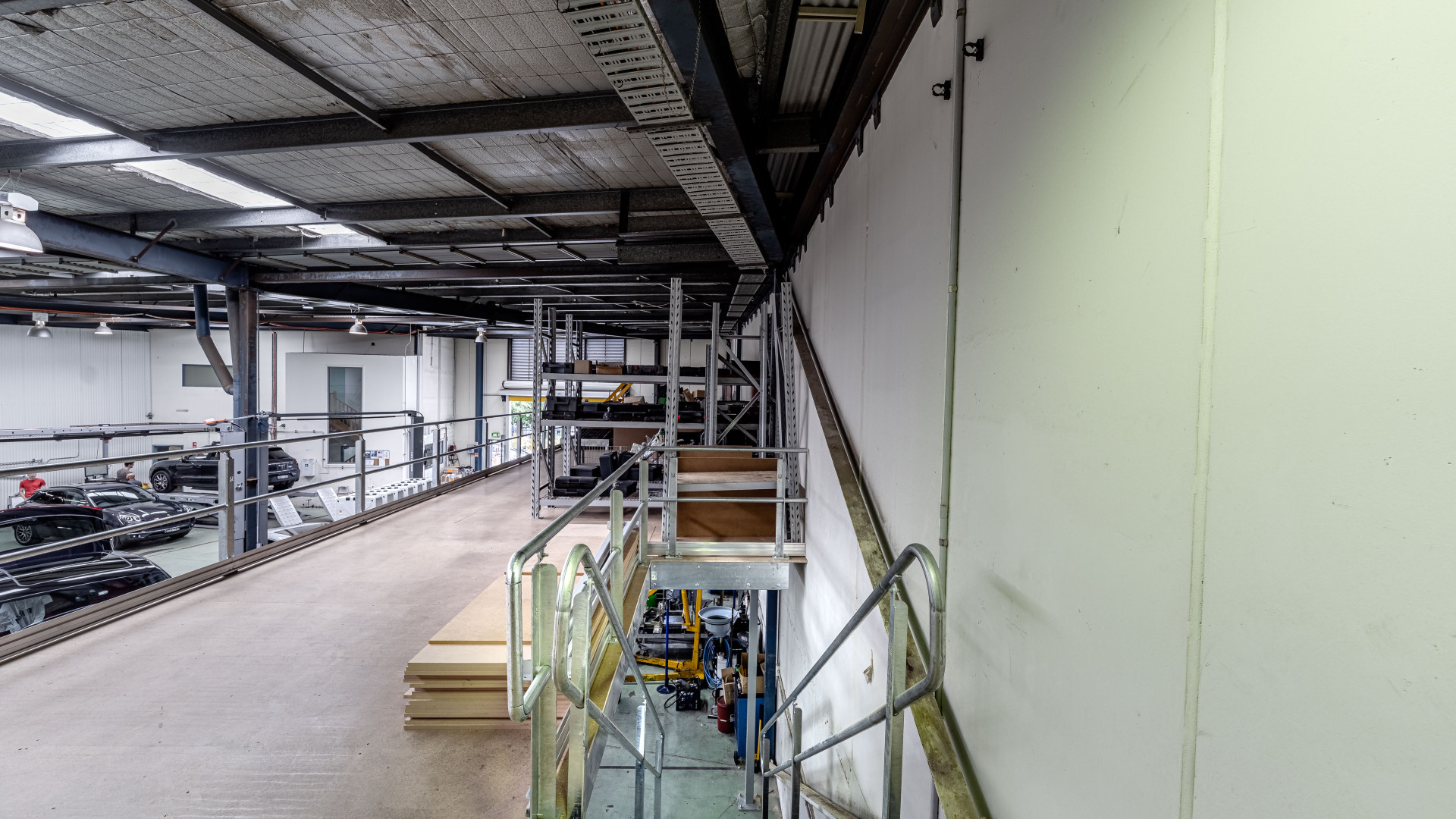
A mezzanine floor that meets structural load requirements can still fail a safety audit and the reason is almost always the access system. Staircases, handrails, and safety gates are the most frequently non-conformant elements found during mezzanine inspections in Australia, yet they are also the most preventable. Each carries distinct compliance obligations under AS 1657:2018, and each represents a separate engineering decision within the broader design process.
The consequences of getting those decisions wrong range from regulatory non-conformance to serious worker injury. Falls from height remain one of the most serious injury categories in Australian workplaces, and mezzanine access points are where that risk is most concentrated. Specifying these elements correctly at the design stage costs significantly less than retrofitting them after installation and it is the only reliable way to ensure a safe working environment from day one.
Staircase design for industrial mezzanines
AS 1657:2018 (Fixed platforms, walkways, stairways and ladders) governs the design and installation of all fixed stairways on industrial mezzanine floors across Australia. The standard defines minimum tread depth, maximum riser height, permitted stair angles, and nosing requirements — all of which directly affect the safety and usability of access routes under normal working conditions.
Non-compliant stair geometry significantly increases slip and trip risk, particularly when workers are carrying loads or moving between levels during peak operational periods. A riser-to-tread ratio outside the prescribed range alters the natural gait rhythm that workers rely on when using familiar access routes, increasing the likelihood of misstep.
AS 1657:2018 specifies a minimum clear width for industrial stairways to allow safe movement and emergency egress. Longer stair runs require intermediate landings at defined intervals, providing a rest point and reducing the consequences of a misstep on an extended flight. These requirements apply regardless of mezzanine use type — storage, office, or production.
Retrofitted stairs on existing mezzanines are a frequent source of non-conformance. When access points are added or modified after initial certification, riser and tread dimensions are often adjusted to fit available space rather than to satisfy the standard. Any staircase modification should be reviewed against AS 1657:2018 and re-certified by a qualified structural engineer.
Handrail systems: heights, load ratings, and fixing requirements
A compliant mezzanine handrail system does more than define the edge of a working platform because it must withstand the lateral forces applied during normal use and in the event of an accidental impact. AS 1657:2018 specifies minimum and maximum handrail heights for industrial mezzanines, along with structural requirements for top rail, mid rail, and kick plate components.
The kick plate (also called a toe board) is a vertical barrier fixed at floor level that prevents objects from being accidentally displaced over the edge of a mezzanine floor. On storage-level platforms where goods are moved close to the perimeter, a missing or undersized kick plate represents a direct risk to workers at the level below.
Handrail posts must be fixed to resist lateral point loads at the top rail, not merely secured in position. Base plate connections are a common inspection failure point: inadequate fixing to the mezzanine floor structure allows posts to deflect or pull free under load, negating the protective function of the entire rail system.
Mid-rail spacing is a defined compliance requirement. The gap between the top rail and the kick plate must not permit a person to pass through or beneath the barrier. Inspectors frequently cite absent kick plates on storage-level edges and incorrect mid-rail height as non-conformances on existing mezzanines, both of which are preventable with correct specification at the design stage.
Self-closing safety gates on pallet loading areas
A self-closing safety gate is a passive barrier system that returns automatically to the closed and latched position after each use, maintaining continuous edge protection at pallet loading points. Pallet gate design is a distinct safety category from standard handrail access: the gate must accommodate forklift-placed loads while keeping the open edge protected throughout the loading and retrieval cycle.
The passive closure mechanism is critical in active loading environments where operators are focused on load placement rather than gate management. A gate that requires deliberate action to close will, under normal operational pressure, be left open, creating an unguarded fall hazard at one of the most frequently used points on the mezzanine perimeter.
Where sequential gate systems are specified, the design requires one side to be fully closed and latched before the other can be opened. This prevents simultaneous open edges at the pallet entry point and ensures that edge protection is maintained throughout the loading cycle. Single-gate configurations must provide equivalent continuous protection through alternative engineering controls where sequential access is not possible.
Safe Work Australia identifies falls from height as a leading cause of workplace fatalities and serious injuries nationally. Pallet gate openings represent one of the highest-risk fixed locations on any mezzanine floor and should be treated as a priority item in both design and ongoing inspection programmes.
Guardrail opening size and fall prevention
The structural requirements for mezzanine guardrail systems address two distinct risks: falls by persons and the displacement of objects onto workers at lower levels. AS 1657:2018 and the National Construction Code (NCC) together define minimum guardrail heights and maximum infill spacing for open-sided mezzanine floors in Australian warehouses.
Maximum permitted infill spacing is set to prevent both limb entrapment and object fall-through. Infill panels, balustrading, and mesh systems all carry the same opening-size obligation — visual adequacy is not a compliance standard. Specifiers must verify that each infill system satisfies the maximum opening dimensions required by AS 1657:2018, regardless of the material used.
Guardrail systems must be engineered to resist both static loads and dynamic impact loads. Static load requirements address the forces applied by a person leaning or pushing against the rail. Dynamic requirements address impact scenarios such as an accidental collision. These are separate structural calculations and must both be addressed in the design documentation.
Perimeter protection design also needs to account for forklift operating zones at lower-level edges. A standard handrail is not an appropriate barrier where vehicle impact is foreseeable. In those zones, a structural safety barrier engineered to resist vehicle loads is required. Confusing these two categories at the specification stage results in a design that satisfies the appearance of compliance without providing the structural protection the site actually requires.
Signage, load rating plaques, and egress clarity
A load rating plaque is a mandatory sign stating the maximum uniformly distributed load (UDL) and point load capacity of a mezzanine floor, as certified by a structural engineer. Under AS 4084:2023 and applicable workplace health and safety legislation, load rating signage is a legal obligation (not an advisory measure) and must be displayed clearly and legibly on the mezzanine structure.
The plaque must reflect the as-installed, certified capacity. Where a mezzanine has been modified, reinforced, or repainted after initial certification, the original signage may no longer represent the current structural rating. Inspectors frequently identify missing or illegible load plaques as a non-conformance on mezzanines that have been altered without updating certification documentation.
Clearance height indicators are required wherever overhead obstructions create a head-strike risk. Emergency egress paths must be clearly marked, maintained at the minimum clear width required by the NCC, and kept free of stored goods at all times. Storing materials on or adjacent to egress routes is among the most commonly cited compliance failures during site inspections.
Maximum travel distance to an exit stair is a fixed requirement under the NCC. Mezzanine layouts that place work areas beyond this threshold, particularly on large-format platforms added after initial construction, may require additional egress provisions. These provisions are significantly easier to incorporate at the design stage than to retrofit after installation.
Common safety failures found in mezzanine inspections
The following categories of deficiency appear consistently across mezzanine safety inspections in Australian industrial facilities. They are not isolated incidents, they are patterns of failure that develop gradually on any site without a structured review programme. Understanding them is the first step toward preventing them.
-
Loose handrail posts. Base plate connections degrade through vibration, corrosion, and repeated lateral loading. Posts that passed initial inspection can develop movement within 12 to 24 months in high-activity environments if connections are not periodically checked and retorqued.
-
Non-functional pallet gate closures. Self-closing mechanisms fail when springs wear, latches corrode, or gates are repeatedly held open with improvised wedges. A gate that no longer closes passively provides no meaningful edge protection regardless of how it was originally specified.
-
Blocked egress routes. Stair landings and egress paths are frequently used as informal storage areas, particularly during peak periods. A compliant egress path at the time of installation may be obstructed during any given inspection.
-
Worn stair nosings. Anti-slip nosing on high-traffic stairways wears unevenly over time. Degraded nosings reduce traction under load-carrying conditions and represent a direct slip hazard on routes used dozens of times each shift.
-
Absent or illegible load rating signage. Repainting, signage replacement, or structural modification can leave load plaques missing, obscured, or inconsistent with the current certified capacity of the floor.
-
Non-compliant stair geometry on retrofitted access. Riser and tread dimensions adjusted to fit available space during a modification frequently fall outside the dimensional requirements of AS 1657:2018, creating a non-conformance that was not present in the original structure.
The role of regular inspection and maintenance
Compliance at installation establishes the baseline, however it does not guarantee ongoing compliance without a structured maintenance and inspection programme. Every component of a mezzanine access system is subject to degradation under the mechanical loads, vibration, and environmental conditions of an active industrial facility.
Handrail post connections loosen, gate latch mechanisms corrode, stair nosings wear, and load signage fades. These changes are gradual and often go unnoticed until they are identified during a formal inspection or, in the worst case, a safety incident. The cost of proactive inspection is consistently lower than the cost of reactive remediation or regulatory response.
AS 4084:2023 recommends periodic inspection schedules for pallet racking systems in Australian warehouses. The same principle of scheduled review applies directly to mezzanine access components. An annual inspection covering handrail post integrity, gate closure function, stair nosing condition, load signage legibility, and egress path clearance provides the documentation trail that demonstrates an active duty of care under WHS legislation.
A structured inspection checklist creates accountability for routine review and provides evidence of compliance management that insurers and regulators expect. Inspection is most effective as a proactive programme, identifying and correcting deficiencies before they reach the threshold of a safety incident or formal non-conformance.
Specifying safety correctly from the outset
Mezzanine safety is an engineering outcome, not a documentation exercise. Staircases, handrails, and access gates each carry distinct compliance obligations under AS 1657:2018, AS 4084:2023, and the NCC — and each must be addressed at the specification stage. Correcting a non-compliant access system after installation consistently costs more, takes longer, and causes greater operational disruption than specifying it correctly from the outset.
Decisions made during design determine whether a mezzanine floor provides a safe working environment from day one or becomes a liability that requires ongoing remediation. Working with an experienced structural partner from the earliest stage of the project is the most reliable way to get those decisions right the first time.
Unistor designs and installs modular mezzanine systems engineered for compliance with AS 1657:2018, AS 4084:2023, and the NCC. Every project includes certified engineering documentation and a structured handover process that covers inspection and maintenance requirements from day one.
Contact us for a mezzanine design that puts safety first.