

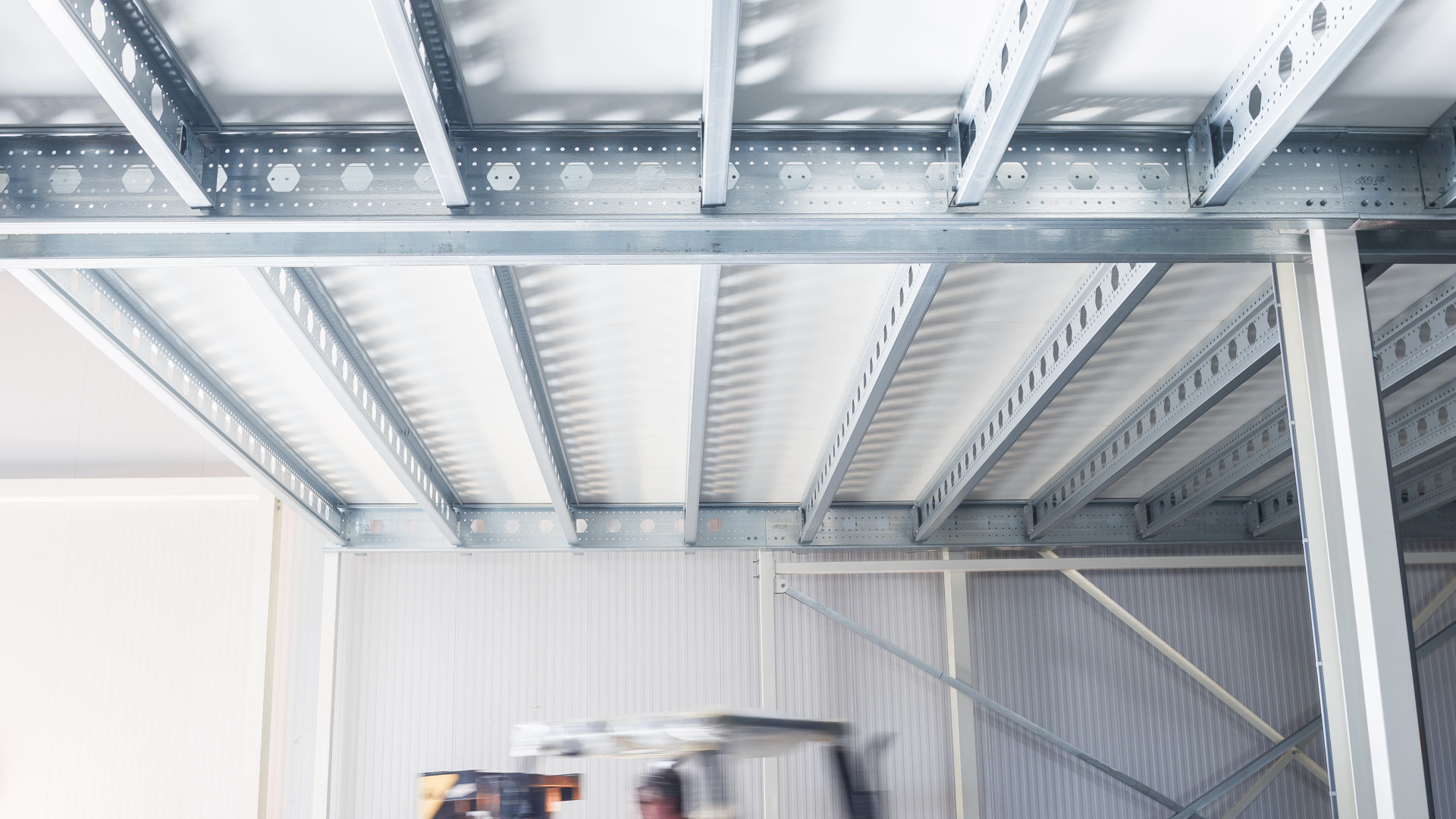
Mezzanine flooring selection is a structural and operational decision with consequences that extend well beyond the initial installation. The deck material determines how much load the floor can carry, how it performs under daily pallet jack and pedestrian traffic, whether it supports fire sprinkler compliance, and how much it costs to maintain or replace over the life of the facility. Choosing the wrong material is an expensive mistake: delamination under rolling loads, non-compliance with AS 1657:2018 (Fixed platforms, walkways, stairways and ladders) or inadequate load capacity can require a full deck replacement within a few years of installation.
The four main mezzanine flooring materials at a glance
Each of the four materials reviewed below suits a different set of operating conditions. Plywood and particleboard are the most widely specified timber-based options. Meiser grating, supplied by Unistor and engineered by Meiser, a specialist grating manufacturer with a global industrial track record, meets specific fire compliance and drainage requirements that solid panel materials cannot. ResinDek composite engineered panels offer the highest load ratings with the lowest deck self-weight. The table below summarises the key comparison points. All load ratings are indicative and must be confirmed with Unistor or the product manufacturer before the specification is issued for tender.
|
Material |
Best-fit use case |
Key limitation |
|
Plywood |
Pedestrian walkways and light goods handling |
Surface wear & delamination under sustained pallet jack traffic; higher cost per m² |
|
Raw particleboard |
Budget-sensitive, light-to-medium duty applications |
Not great in high humidity and moisture areas |
|
38 mm Unilin particleboard |
Heavy rolling loads and pallet jack areas |
Higher upfront cost than standard particleboard |
|
Meiser grating |
Fire-compliant installations where sprinkler pass-through is required |
Not suited to extended pedestrian comfort; serrated or anti-slip bar profile required per AS 1657:2018 |
|
ResinDek composite panels |
High-throughput and automation-ready platforms |
Cost premium over timber options; cost & install advantages vs concrete |
Plywood mezzanine flooring
Plywood is one of the most commonly specified mezzanine deck materials and performs well in applications where loads are moderate and traffic is predominantly pedestrian or involves light goods handling. Its cross-laminated construction gives it good resistance to point loads and predictable structural behaviour across a span, and it is widely available from Australian suppliers with short lead times. However, plywood carries a higher material cost per square metre than particleboard and is not always the right choice for environments where pallet jacks operate continuously across the deck surface.
Load capacity and rolling load performance
Plywood mezzanine flooring provides reliable distributed load capacity for pedestrian walkways and light goods handling operations. The load rating varies between 3-5KPA depending on sheet thickness and grade; structural grades in 19 mm and 25 mm thicknesses are most commonly specified for mezzanine applications. Rolling load resistance, i.e. the capacity to withstand repeated pallet jack wheel loads without surface failure, is acceptable in low-to-medium traffic conditions but degrades under constant shift-cycle pallet jack use. In high-throughput environments with sustained rolling loads, the surface veneer can deteriorate and the panel can develop localised delamination at the wheel contact points over time.
Fire compliance and deck weight
As a solid panel material, plywood does not support sprinkler pass-through. In installations where the fire compliance strategy requires overhead sprinkler water to reach the level below the mezzanine deck, plywood is not appropriate and Meiser grating must be specified instead. Confirm the fire compliance requirement with the building surveyor before selecting any solid panel material. Under AS 1657:2018, the plywood surface must meet the slip resistance standard for the anticipated foot and equipment traffic; a non-slip coating or surface treatment may be required depending on the sheet specification.
Particleboard mezzanine flooring
Particleboard is the most cost-effective of the four materials and is widely used in mezzanine applications where the budget is constrained and loads are light to medium. Standard raw particleboard performs adequately for pedestrian-only or light storage applications, but it has a well-documented limitation: it is susceptible to delamination and surface failure under the repeated point loads imposed by pallet jack wheels. Specifying the wrong grade of particleboard for a pallet jack environment is one of the most common causes of premature mezzanine deck failure in Australian warehouses.
Standard particleboard: cost and limitations
Standard raw particleboard is a budget-appropriate choice for mezzanine applications that involve light pedestrian traffic and no rolling equipment. Its compressive strength is adequate for static storage loads, but the particulate structure of the panel is not engineered to resist the concentrated, repeated wheel loads of a pallet jack or order-picking trolley. In environments where rolling equipment operates regularly, the surface can fail at the wheel contact zone within months of installation, requiring panel replacement well ahead of the expected service life. Specifying standard particleboard in a pallet jack environment to reduce upfront cost typically increases the total cost of ownership.
38 mm Unilin particleboard: premium rolling load performance
Unilin 38 mm high-density particleboard is engineered specifically to resist heavy rolling loads without delamination, making it the appropriate particleboard specification for mezzanine environments where pallet jacks or order-picking trolleys operate continuously. The increased panel thickness and high-density core structure distribute wheel loads across a wider contact area, reducing the point stress that causes standard particleboard to fail. This makes Unilin 38 mm the standard particleboard recommendation for pallet jack corridors and pick-and-pack decks where budget constraints make composite panels a secondary option.
Meiser grating
Meiser grating is the open-deck flooring option supplied by Unistor for mezzanine applications that require sprinkler pass-through or drainage. Manufactured by Meiser, a specialist grating producer with an established international industrial track record, the product range available through Unistor includes heavy-duty gratings for high-load applications, slip-resistant gratings for safety-critical environments and custom-designed gratings for non-standard layouts and finishes. Finishes include galvanised steel for corrosion resistance and powder coating in high-visibility colours where site safety requirements demand it.
The defining structural property of Meiser grating is its open-bar construction. Because the deck surface is formed by parallel steel bars with open gaps between them, water from overhead fire suppression systems passes vertically through the floor to the level below. This makes Meiser grating the only appropriate deck material in installations where the fire compliance strategy requires sprinkler water to reach below-deck areas, a non-negotiable requirement that overrides cost, comfort and aesthetic considerations.
Load, weight and compliance properties
Meiser grating is available in heavy-duty bar profiles that support high distributed and point loads, making it suitable for forklift-adjacent zones and industrial multi-level platforms as well as standard warehouse mezzanine applications. The steel bar construction adds more dead load per square metre than timber or composite panel options, which must be accounted for in the structural engineer's load schedule. Under AS 1657:2018, grating used in pedestrian applications must meet the slip resistance standard; Meiser's slip-resistant grating range addresses this requirement through serrated bar profiles and surface treatments designed to prevent slips and falls in high-traffic areas. All Meiser grating supplied by Unistor complies with Australian safety standards and is accompanied by compliance documentation.
The extended pedestrian comfort limitation associated with open-bar grating surfaces is a known ergonomic consideration: workers who stand or walk on grating for extended periods can experience foot and leg fatigue. Where the installation involves sustained pedestrian activity, this should be raised with the project team at the design stage and anti-fatigue matting or an alternative panel material for pedestrian zones should be considered.
Meiser grating is the correct specification when one or more of the following conditions applies:
-
The fire compliance strategy requires sprinkler water to pass through the mezzanine deck to the level below
-
The building surveyor or fire engineer has specified an open-deck material as a condition of the fire safety report
-
The installation is in a drainage zone where liquid spillage or washdown must pass through the floor to a drain below
-
The structural design accommodates the higher dead load of a steel grating deck
-
The nominated Meiser slip-resistant bar profile meets AS 1657:2018 for the intended foot and equipment traffic
ResinDek composite engineered panels
ResinDek composite engineered panels are the highest-performance mezzanine deck material reviewed here and the appropriate choice for high-throughput environments, automation-ready platforms and installations where load capacity and deck longevity are the primary design criteria. The composite construction (a structural fibre core with a resin-impregnated surface layer) delivers high load ratings and rolling load resistance in a panel that is lighter per square metre than a concrete deck and lighter than equivalent-rated steel or timber options. ResinDek panels are reported to be up to 34% more cost-effective than concrete mezzanine flooring when installed cost is compared; this figure must be confirmed with Unistor or the ResinDek manufacturer before it is included in any client-facing specification or proposal.
Automation and high-throughput applications
ResinDek panels are the preferred specification for mezzanine platforms designed to accommodate conveyor systems, autonomous mobile robots (AMRs) or automated storage and retrieval systems (ASRS) either at installation or in future. The consistent surface flatness and deflection characteristics of composite panels are critical for AMR navigation, where surface irregularity or panel deflection under load can cause equipment errors or require recalibration. The high load rating and durability of ResinDek also supports the sustained concentrated loads imposed by conveyor support legs and ASRS mast columns, though the structural engineer must verify column and beam capacity independently for these applications. For warehouse fit-outs that integrate automation alongside the mezzanine structure, ResinDek provides the most appropriate structural foundation.
How to choose: a decision framework by use case
Material selection should follow the operating conditions of the deck, not the available budget. Budget constraints are a legitimate input to the decision, but they should influence the choice between materials that meet the structural and compliance requirements — not override those requirements. The table below maps common warehouse use cases to the appropriate deck material, the load priority for each scenario and the compliance considerations that must be addressed before the specification is finalised.
|
Usage type |
Recommended material |
Load priority |
Compliance note |
|
Pedestrian only |
Plywood or ResinDek |
Standard distributed live load |
AS 1657:2018 slip resistance and guarded edge protection required |
|
Pallet jack corridors |
38 mm Unilin particleboard or ResinDek |
Rolling load resistance critical |
Confirm rolling load rating and span with Unistor before specifying |
|
Forklift-adjacent zones |
ResinDek or Meiser grating |
High point and distributed loads |
Structural engineer to verify column and beam capacity independently |
|
Fire-regulated installation |
Meiser grating |
Sprinkler pass-through mandatory |
Confirm fire compliance provision with certifier and building surveyor |
|
Cold storage facility |
ResinDek or treated plywood |
Moisture and temperature cycling resistance |
Confirm material suitability for operating temperature range with Unistor |
The decision framework above is a starting point, not a final specification. Every mezzanine deck installation involves site-specific variables such as span lengths, support beam spacing, equipment weights and fire compliance provisions that affect the material selection. Confirm the final specification with Unistor's engineering team before issuing for tender.
How architects and engineers should specify mezzanine flooring
Mezzanine deck specification sits at the intersection of the structural design, the fire safety report and the operational brief. Getting the specification right requires coordination across all three: a deck material that meets the structural engineer's load schedule, satisfies the fire compliance provisions in the building surveyor's report, and performs under the actual operating conditions described by the client. The checklist below sets out the specification items that must be addressed before the deck material is confirmed and issued for tender.
|
Specification item |
Guidance for architects and engineers |
|
Panel thickness |
State minimum thickness for the span and load class — confirm with Unistor. Standard particleboard is typically 19 mm for light duty; Unilin is 38 mm for rolling load applications. |
|
Load rating (kPa or kg/m²) |
Coordinate deck panel load rating with the structural engineer's imposed load specification. Confirm rated values from the product data sheet before issuing to tender. |
|
Rolling load resistance |
State the maximum rolling load in kilograms for pallet jack wheels. This figure must appear in the specification and be sourced from the product data sheet. |
|
Slip resistance |
Reference AS 1657:2018 requirements. Meiser grating requires a serrated or anti-slip bar profile; composite and timber panels may require a surface coating or treatment depending on the installation. |
|
Sprinkler pass-through |
Specify whether the fire compliance strategy requires an open-deck material — such as Meiser grating — to allow sprinkler water to reach the level below. Confirm the requirement with the building surveyor. |
|
Deck self-weight (kg/m²) |
Include the deck panel self-weight as a dead load in the structural engineer's load schedule. Confirm the value from the product data sheet for each material under consideration. |
|
Certification documentation |
Request product certification or test reports from the supplier for load rating and rolling load claims before issuing for construction. Meiser grating and Unistor's other flooring products are supplied with compliance documentation. |
AS 4084:2023 (Steel storage racking) is relevant where the mezzanine interfaces with a racking system that forms part of the structural frame. In these configurations, the deck specification must coordinate with the racking system design to confirm that load transfer between the deck and the racking columns is within the rated capacity of both systems. This coordination is best addressed early in the design phase, before the deck specification is issued. Unistor provides early design assistance and specification support to architects and project managers to resolve these interface questions before they become variations during construction.
Matching flooring to the structural system
The four materials reviewed here represent distinct structural and operational choices, not equivalent alternatives. Plywood suits light-duty pedestrian applications at moderate cost. Standard particleboard suits budget-constrained, low-traffic installations where rolling equipment is absent. Unilin 38 mm particleboard extends particleboard's applicability to pallet jack environments. Meiser grating meets fire compliance obligations and drainage requirements that solid panel materials cannot satisfy. ResinDek composite panels deliver the highest load ratings, the best rolling load resistance and the flattest surface for automation integration.
The decision between them is determined by load requirements, usage type, fire compliance obligations and lifecycle cost, in that order. A deck that fails its compliance obligations or structural requirements is not a cost saving; it is a liability. Unistor's engineering team works with architects, project managers and warehouse managers at the specification stage to confirm that the selected deck material matches the structural system, meets the compliance requirements and performs under the actual operating conditions of the facility. Unistor has supplied and installed Meiser grating alongside Unilin particleboard and ResinDek panels across warehousing, logistics and manufacturing projects nationally for over thirty years. Contact our team to discuss your mezzanine flooring specifications.