

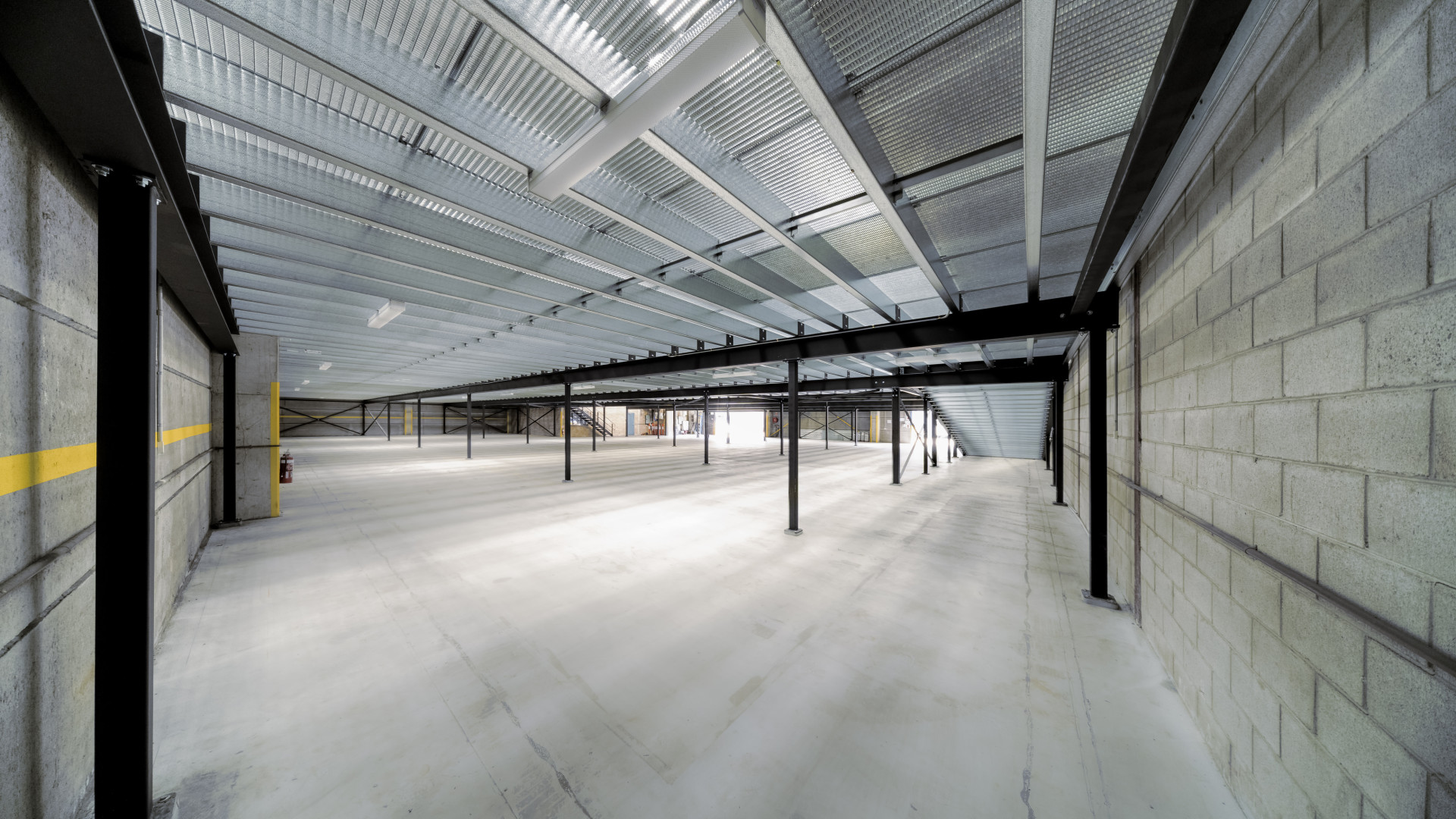
Phased mezzanine installation is not a scheduling convenience. It is a project management discipline with direct consequences for warehouse throughput, service level agreement performance and the commercial outcomes of every client contract running through the facility during the build. The difference between an installation that the warehouse absorbs without incident and one that triggers SLA breaches, stock dislocations and safety interventions is almost never the structural design. It is the quality of the planning that happens before steel arrives on site.
Unistor's mezzanine floor systems are designed and installed with this operational discipline built into the project scope from the outset, not added as an afterthought once the structural program is already fixed.
What phased installation means in practice
Phased mezzanine installation means dividing the build into discrete, sequenced stages, each contained within a defined area of the warehouse, each completed to a usable interim state before the next begins, and each planned around the operational constraints of the facility rather than the preferences of the installation crew. It is not the same as simply starting at one end of the warehouse and working toward the other. Done correctly, it requires the same level of planning as the structural design itself.
Construction zones
A construction zone is a defined area of the warehouse floor that is handed to the installation team for the duration of a phase. Its boundaries determine which parts of the facility remain available to the operational team at every point during the build, and those boundaries must be established in the installation plan before works begin.
Construction zone boundaries set reactively on site, in response to what the installation crew needs on a given day, create unpredictable access restrictions that the operational team cannot plan around. Boundaries that are defined, documented and communicated in advance allow the warehouse operations team to adjust pick routes, relocate stock and brief staff before the restriction takes effect rather than in response to it.
Physical barriers, signage and defined pedestrian paths must separate the construction zone from the operational floor at all times during each phase. The separation is not a courtesy; it is a work health and safety requirement under the Work Health and Safety Act 2011, and it must be established before installation activity begins in the zone, not after.
Steel erection sequencing
Steel erection is the highest-impact activity in a mezzanine installation. Column setting, beam placement and deck installation require overhead work, lifting equipment access and the temporary closure of the floor area directly below the active erection zone. The sequence in which structural bays are erected determines which pick faces are unavailable at each stage of the build and for how long.
An erection sequence optimised for installation efficiency without reference to the pick face layout will close the highest-volume pick faces at the time that suits the installation crew, not the time that the warehouse can best absorb the loss. The result is compressed pick routes, increased travel times, higher error rates and throughput shortfalls that accumulate across each affected shift.
Steel erection should be scheduled for off-peak shifts, overnight windows or weekend periods where the operational impact is lowest. Where the facility operates around the clock and no low-impact window exists, the erection sequence must be designed to minimise the duration of each pick face closure and to stage the closures so that no two adjacent faces are unavailable simultaneously.
Temporary access arrangements
Every construction zone boundary that closes an established pedestrian or forklift path requires a documented alternative route before the closure takes effect. An alternative route that is identified on site, on the day the zone is established, is not an alternative route. It is an improvised workaround, and improvised workarounds in live warehouse environments create the conditions for access conflicts, near-miss incidents and work health and safety interventions that pause the installation without resolving the operational impact.
Temporary walkways and access structures installed as part of the construction program must meet the requirements of AS 1657:2018 (Fixed platforms, walkways, stairways and ladders) regardless of how briefly they are in use. Temporary does not mean unregulated. A temporary stair that does not meet the gradient, width, handrail and landing requirements of AS 1657:2018 is non-compliant regardless of its intended service life, and a walkway that carries personnel in a live warehouse must be constructed to a standard that prevents deflection or movement underfoot.
All alternative access routes must be signed, lit and communicated to all shifts before each phase begins. A route that operational staff discover by following a barrier around a construction zone is not a communicated alternative; it is an unmanaged change to the working environment.
Aligning installation phases with operational realities
The installation program must be built around the facility's operational constraints, not the other way around. Three constraints shape the timing of every phase boundary in a live warehouse mezzanine build: shift patterns, seasonal demand cycles and lease milestones. All three must be mapped before the program is drafted, and all three must remain visible throughout the project as the reference points against which scheduling decisions are assessed.
Shift patterns
Steel erection, concrete penetrations and overhead installation work should be scheduled during shift changeovers, night shifts or non-operational windows to reduce the exposure of working staff to noise, dust and access restrictions. A program that assumes daytime access to a twenty-four-hour facility will encounter its first conflict at the first phase boundary and will not recover without either compressing the program or accepting operational disruption that was not planned for.
The installation program must incorporate the actual shift roster of the facility, including shift changeover times, planned overtime windows and any rostered shutdown periods that create uninterrupted installation windows. This information comes from the operational audit conducted before design begins, and it must be confirmed with the warehouse operations manager before the program is finalised.
All shifts must be briefed separately before each phase begins. A pre-phase briefing conducted only with the day shift does not reach the afternoon or night shift teams who will encounter the changed construction zone boundary and the altered access arrangements during their working hours. A changed floor layout that operational staff encounter without prior notice is a safety risk and a source of throughput loss that could have been prevented by a fifteen-minute briefing.
Seasonal demand cycles
Peak trading windows are the highest-risk periods for a live mezzanine installation. Pre-Christmas, end of financial year and major promotional events compress the available pick faces, increase the volume of stock moving through the facility and reduce the tolerance of the operational team for any disruption that is not absolutely unavoidable. Scheduling the most disruptive installation phases, steel erection and deck installation, during these windows is one of the most reliable ways to turn a manageable build into a commercial problem.
Phase boundaries should be timed so that construction zones are established and returned to operational use outside peak trading windows. Where the overall program cannot avoid a peak period entirely, the sequence must be structured so that the lowest-impact phases, services installation, lighting and signage, occupy the peak window, while steel erection and deck work are completed before or after it.
The seasonal demand profile of the facility must be documented before the installation program is drafted. For 3PL operators managing multiple client contracts, the peak profiles of different clients may overlap or conflict, and the installation program must account for the combined demand picture across the facility, not the peak profile of a single client.
Lease milestones
Lease expiry, renewal and fitout contribution clauses impose fixed deadlines on the mezzanine program that cannot be negotiated on site once works have begun. A fitout contribution from the landlord that is contingent on practical completion by a specified date, a rent-free period tied to commencement of works, or a make-good obligation triggered by failure to complete within the lease term are all program constraints that must be identified and incorporated into the installation timeline before the program is drafted.
The installation program must work backward from lease milestones to determine the latest possible start date for each phase, with contingency built into each phase to absorb delays without compressing the final phase to the point where completion by the milestone date becomes contingent on everything proceeding without interruption. Programs with no contingency are not tight programs; they are programs that will miss their milestones.
Where a fitout contribution is contingent on practical completion by a specified date, the installation program should be structured to achieve that milestone with the available lead time, including time for structural certification and documentation handover, not optimised to start as late as possible and rely on accelerated installation to make up the difference.
The SLA and throughput risks of uncoordinated installation
An uncoordinated mezzanine installation in a live warehouse does not create a single large disruption that is visible and manageable. It creates a series of smaller disruptions, each one individually absorbable, but cumulatively sufficient to degrade throughput, erode SLA performance and, in a 3PL environment, create the conditions for financial penalties and damaged client relationships. The cost of unplanned downtime during a mezzanine installation is almost always greater than the cost of the additional planning required to prevent it.
The specific risks that uncoordinated installation creates include:
|
Coordination failure |
Operational consequence |
|
Pick face closed without prior stock relocation |
Pickers default to alternative locations, increasing travel time and pick error rates across all affected shifts |
|
Access restriction introduced without advance notice |
Forklift operators use unplanned routes, increasing collision risk and triggering mandatory incident reporting |
|
Steel erection scheduled during inbound or outbound dispatch window |
Receipt and shipment delayed, affecting on-time delivery performance and SLA compliance |
|
Construction zone boundary expanded without communication |
Operational team loses access to stock or equipment without warning, creating throughput gaps that accumulate across the shift |
|
Overhead work conducted during operational shifts without exclusion zone |
Noise and dust require work health and safety intervention, pausing installation without resolving the operational impact |
|
Phase transition not communicated to all shifts |
Night or afternoon shift encounters changed layout without briefing, creating safety risk and productivity loss |
|
SLA breach caused by installation disruption in 3PL environment |
Breach flows through to client contract, triggering financial penalty or early termination right |
For 3PL operators, the commercial exposure is compounded by the fact that installation disruption is not a force majeure event under most logistics contracts. A throughput shortfall caused by a mezzanine installation that the operator chose to proceed with during an active client contract period is an operational failure, not an exceptional circumstance, and it is the operator who absorbs the financial consequence.
The operational cost of an uncoordinated installation is not theoretical. Every unplanned pick face closure adds travel time to every pick conducted from an alternative location for the duration of the closure. Every unannounced access restriction adds decision time and deviation distance to every forklift movement in the affected area. Across a facility processing thousands of picks and hundreds of forklift movements per shift, these incremental costs accumulate rapidly into throughput figures that are visible in the weekly performance report and commercially significant in the monthly client review.
What a phased installation plan document should contain
A credible phased installation plan is a project deliverable, not an internal construction document. It should be produced by the installation partner before works commence, reviewed and approved by the warehouse operations manager and used as the reference document for all phase transitions throughout the build. A plan that exists only as a verbal understanding between the project manager and the site supervisor is not a plan; it is a shared assumption that will be interpreted differently at the first point of conflict.
The documents and components that a phased installation plan must contain include:
Zone maps Floor plans drawn to scale showing the construction zone boundary at each phase of the build, the operational floor area remaining available to the warehouse team, the location of exclusion zones during high-impact activities, and the temporary pedestrian and forklift routes that replace those closed by the construction zone boundary. Zone maps should show the facility at each phase transition, not only the finished state, so that all parties share a common understanding of what the floor looks like at every point during the build.
Programme Gantt chart A phase-by-phase timeline showing the planned start and end date of each construction activity, the shift windows during which overhead or high-impact work is scheduled, the key milestones at which each construction zone is returned to operational use, and the contingency periods built into the program between phases. The Gantt chart must reflect the actual shift roster of the facility and the seasonal demand profile documented in the operational audit.
Access exclusion zones Documented definitions of the areas within or adjacent to the construction zone where operational personnel and equipment are excluded during specific high-impact activities such as column setting, beam lifting and overhead deck installation. Each exclusion zone definition must specify the physical boundaries of the zone, the duration of the exclusion and the method by which the boundary is established and communicated to operational staff before the activity begins.
Interim egress arrangements Documented alternative egress routes for each phase of the build, confirming that all personnel on the operational floor have a clear, signed and lit path to a fire exit at all times during construction. Interim egress arrangements must meet the requirements of the National Construction Code for the building class regardless of the phase, and they must be established before the construction zone boundary closes any existing egress path.
Stock relocation schedule A plan for relocating stock from zones that will be closed during construction, including the destination location for relocated stock, the timing of each move relative to phase commencement, and the process for updating picking system records before the affected pick faces go offline. Stock moves that happen after the construction zone is established, rather than before it, create the pick face availability problems that the relocation schedule is designed to prevent.
Communication plan A schedule of pre-phase briefings for all shifts, naming the internal contact for construction-related queries, the process for notifying staff of phase transitions and the channel through which changes to the construction program are communicated to the operational team. A communication plan that covers only the initial project briefing and does not address phase-by-phase communication is not adequate for a live mezzanine installation.
Safe Work Method Statement Documentation covering all high-risk construction activities and their specific interaction with live warehouse operations, reviewed and confirmed as adequate before each phase begins. A Safe Work Method Statement that addresses the construction activities in isolation, without reference to the live-environment context in which they are taking place, does not provide adequate assurance that the risks created by the interaction between construction and operations have been identified and controlled.
How a single project partner reduces coordination risk
The gap between the structural designer, the steel fabricator and the installation contractor is the primary source of program risk in a live mezzanine installation. Each party has its own schedule, its own priorities and its own definition of what constitutes a successful outcome. The coordination between them falls to the operations manager or project manager to absorb, and in a live warehouse environment, that coordination burden competes directly with the operational priorities that do not pause during construction.
A delayed fabrication delivery that pushes a phase start date into a peak trading window is not a structural failure. It is a coordination failure between the design team and the fabricator, and it has operational consequences that neither party planned for and neither party is primarily accountable for resolving. An erection sequence that closes the highest-volume pick face first is not an installation decision made in the interests of the warehouse. It is a scheduling preference of the installation crew that was never reviewed against the pick face layout because the person who knew the pick face layout and the person planning the erection sequence were not working from the same document.
These failures are predictable when multiple contractors operate in a live warehouse without a single accountable program owner. They are preventable when one team holds responsibility for design, fabrication and installation under a single program and carries accountability for the operational consequences of every scheduling decision made within that program.
Unistor's design-and-build model covers the full scope of a mezzanine installation, from operational audit and layout design through to structural fabrication, phased installation and certification handover. One project manager is the point of contact for the warehouse operations team throughout the build. The erection sequence is reviewed against the pick face layout before it is fixed. The fabrication program is confirmed against the operational calendar before phase dates are committed. The phased installation plan is produced, reviewed and approved before steel arrives on site.
For 3PL operators and distribution centres where SLA exposure makes installation disruption commercially significant, single-partner accountability is not a convenience. It is a risk management decision with a measurable commercial rationale.
How Unistor's project management model is structured around client operations
Unistor's project management model starts with the operational audit, which establishes the throughput flows, shift patterns, peak trading windows and SLA constraints that shape every phase boundary in the installation program. The audit is not a preliminary formality; it is the document from which the installation program is built, and it is conducted before the structural design is finalised so that the design and the program are developed together rather than sequentially.
The phased installation plan is produced as a standard project deliverable for every live mezzanine build, not as an optional add-on for clients who ask for it. The plan includes zone maps, a programme Gantt chart built around the facility's actual shift roster, access exclusion zone documentation, interim egress arrangements confirmed against NCC requirements, a stock relocation schedule coordinated with the warehouse operations team, and a communication plan that covers every phase transition from the first construction zone boundary to the final certification handover.
Phase transitions are managed by Unistor's project team. Pre-phase briefings are conducted for all affected shifts before each phase begins. Construction zone boundaries are established before installation activity commences in the zone. The operational floor is handed back to the client at the end of each phase in a documented interim state, with the access arrangements, pick face availability and egress routes confirmed before the construction crew moves to the next zone. For projects that include racking integration or warehouse fit-out works alongside the mezzanine build, the full structural scope is managed under one program, with one project team accountable for the interface between construction activity and live operations throughout.
Phased installation is a discipline, not a default
The outcome of a live mezzanine installation is determined by the quality of the planning that precedes it, not the speed of the installation itself. A phased program that is built around the facility's operational realities, that documents every zone boundary and phase transition before works begin, and that is managed by a single team accountable for both the structural outcome and the operational impact, consistently delivers better results than a faster program managed by multiple parties with divided accountability. The warehouse that keeps running throughout a mezzanine build is not the one where disruption was accepted as inevitable. It is the one where it was planned out before the first column was set.
Book a free site assessment to start planning a phased mezzanine installation around your operations.