

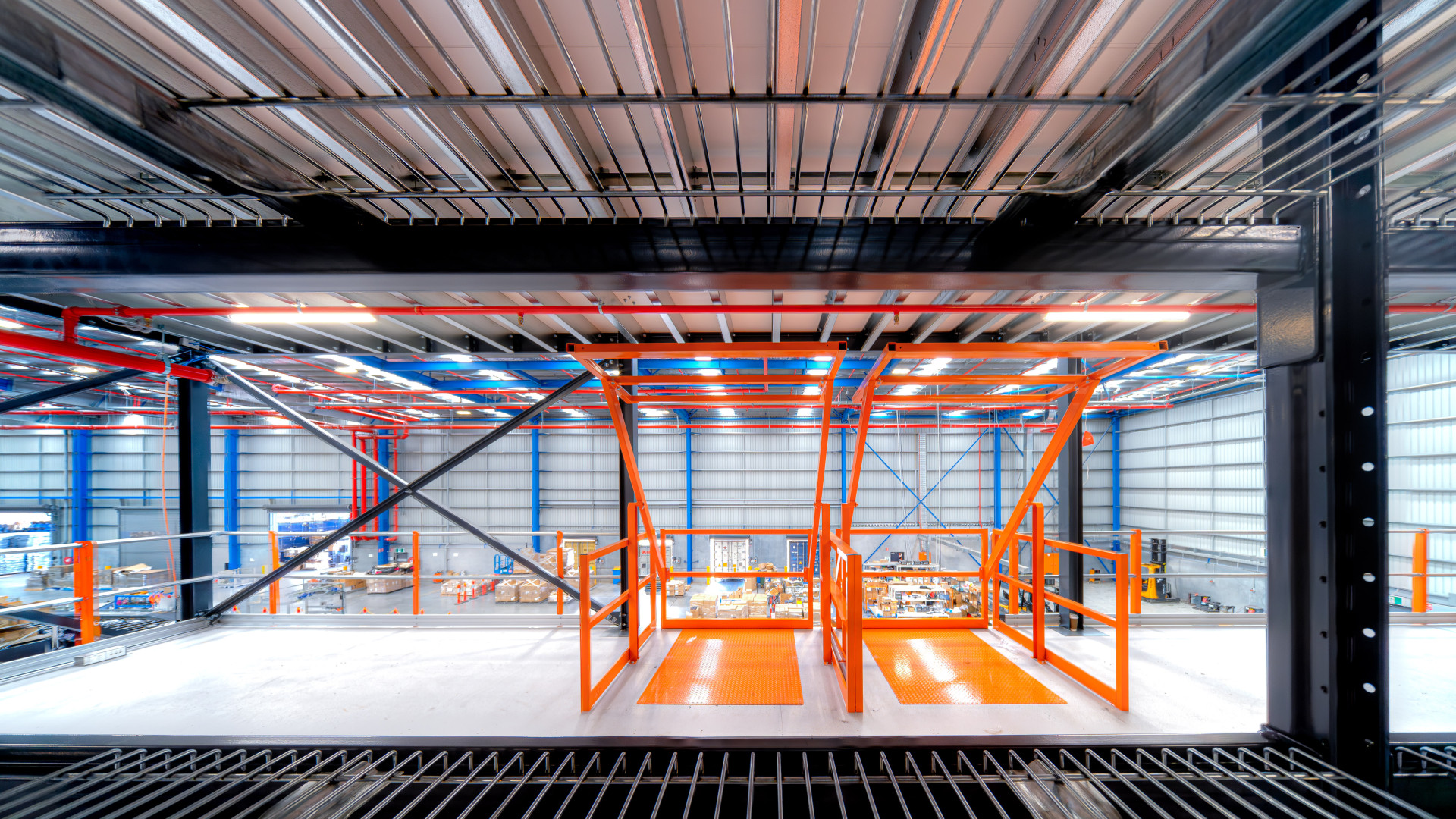
Should your mezzanine be manufactured in a factory or built on-site? The answer affects installation time, compliance certainty and the operational disruption your facility will experience during construction. Prefabricated mezzanines are engineered and manufactured off-site in controlled factory environments before delivery and assembly on location. Site-built mezzanines are fabricated and constructed largely on-site using raw materials and traditional construction methods. Each approach carries distinct implications for project timelines, quality control, safety and long-term flexibility. Understanding these differences allows architects, engineers and facility managers to select the approach that best aligns with project constraints and operational requirements.
What Is a Prefabricated Mezzanine System
Prefabricated mezzanines are engineered structural systems manufactured in factory-controlled environments before transportation to site for assembly. Components including beams, columns, decking and stairs are fabricated to precise specifications using computer-aided design and automated manufacturing processes that ensure dimensional accuracy and material consistency.
Precision fabrication reduces dimensional tolerances compared to site-based construction. Factory equipment including CNC cutting systems, automated welding stations and jigs maintain consistent quality across identical components. This precision ensures that components fit together correctly during site assembly without requiring field modifications that can compromise structural integrity or delay installation.
Pre-engineered structural members are designed, analysed and certified before manufacturing begins. Structural engineers develop detailed calculations demonstrating compliance with AS 4100 steel structures standards and relevant loading requirements. This engineering is completed before any material is cut, providing certainty that the delivered system will meet specified performance requirements.
Controlled quality checks occur throughout the manufacturing process rather than relying solely on final inspection. Welds are performed in optimal conditions without exposure to weather, wind or temperature variations that affect site welding quality. Materials are stored in covered facilities preventing corrosion or damage before assembly. Dimensional checks verify that components meet engineering tolerances before they leave the factory.
Reduced on-site welding and cutting minimises hot works permits, fire risk and construction safety hazards. Most structural connections use bolted assemblies that can be installed without welding equipment or gas cutting tools. This approach reduces safety risks and allows installation in operational facilities where hot works would be prohibited or require extensive safety measures.
Compliance alignment during manufacturing ensures that completed systems meet National Construction Code requirements and Australian Standards before delivery. Factory processes are documented and traceable, providing evidence of material specifications, welding procedures and quality verification that certifiers require for approval. This upfront compliance reduces the risk of on-site defects requiring rectification or redesign.
What Is a Site-Built Mezzanine
Site-built (or custom) mezzanines are constructed largely on-site using steel sections, decking materials and components that are cut, welded and assembled in their final location. Fabrication occurs within the warehouse or facility where the mezzanine will operate, with structural members erected progressively as construction advances.
Higher dependence on on-site labour means project timelines are more vulnerable to workforce availability, skill variations and contractor scheduling. Multiple trades including steel fabricators, welders, riggers and finishers must coordinate their activities in sequence, with delays in one trade affecting downstream work. Labour quality varies between individual tradespeople, creating potential inconsistencies in welding, alignment and finishing that may not become apparent until later construction stages.
Variable environmental conditions affect construction quality and worker productivity. Rain, wind, temperature and humidity influence welding quality, material handling and worker safety. Hot weather creates heat stress risks while cold conditions affect material properties and welding parameters. Outdoor or semi-enclosed construction sites expose materials to corrosion and contamination before protective coatings are applied.
Greater construction footprint during build requires larger exclusion zones within operating facilities. Raw materials, fabrication equipment, welding stations and temporary works occupy floor space that cannot be used for normal operations. Scaffolding, safety barriers and construction traffic create disruption extending beyond the mezzanine footprint itself.
Increased coordination complexity arises from managing multiple on-site activities simultaneously. Site managers must coordinate material deliveries, equipment access, safety permits and trade activities while maintaining facility operations. Changes identified during construction may require redesign, additional materials or rework that extends timelines and increases costs.
Installation Time and Operational Disruption
Prefabricated systems significantly reduce on-site installation time compared to site-built construction. Factory-manufactured components arrive ready for assembly, eliminating the fabrication time required for cutting, welding and finishing structural members on-site. Installation crews focus on assembly and connection rather than manufacturing, allowing faster project completion.
|
Aspect |
Prefabricated Systems |
Site-Built Systems |
|
Typical installation duration |
2-3 weeks for standard installations |
6-12 weeks or longer |
|
Lead time |
2-3 weeks manufacturing plus installation |
1-2 Weeks procurement |
|
Weather dependency |
Minimal - assembly only |
High - affects entire construction process |
|
Facility disruption |
Limited to assembly period and access routes |
Extended disruption throughout construction |
|
Parallel activities |
Manufacturing occurs while site preparation progresses |
Sequential on-site activities |
Predictable program timelines result from controlled manufacturing schedules that are less susceptible to weather delays or material availability issues. Factory production follows established schedules with known lead times, allowing accurate project planning and coordination with other facility activities. Site assembly duration can be estimated reliably based on component quantities and crew productivity.
Less interruption to warehouse operations occurs when installation periods are shorter and construction activities are concentrated. Prefabricated installations may be scheduled during lower-volume periods or completed in stages that maintain partial facility operation. Reduced construction duration limits the time that floor space remains inaccessible or operational workflows must be modified.
Site-built construction extends on-site construction periods significantly due to sequential fabrication and assembly activities. Each structural member must be measured, cut, positioned and welded before the next component can be installed. Weather delays, material delivery interruptions or trade availability issues compound throughout the extended construction period, making completion dates less predictable.
Greater exposure to delays affects project certainty and facility planning. Extended construction periods increase the probability that unforeseen issues will emerge, from weather events to design modifications or compliance matters identified during certification. Facilities must accommodate construction disruption for longer periods, affecting inventory management, order fulfilment and operational efficiency.
Quality Control and Compliance
Factory fabrication improves quality consistency and traceability compared to site-based construction methods. Manufacturing environments provide controlled conditions, standardised processes and documented quality procedures that ensure structural components meet engineering specifications before leaving the factory.
Manufacturing to Australian Standards follows documented processes with quality checkpoints at each production stage. Welding procedures are qualified to AS 1554 structural steel welding standards, with welders certified and their work subject to inspection protocols. Material certifications verify that steel sections meet AS 3679 specifications for strength, ductility and chemical composition. These quality measures are embedded in factory processes rather than relying on site-based inspection after work is complete.
Controlled welding conditions eliminate variables that compromise weld quality in site environments. Factory welding occurs in enclosed spaces protected from wind, rain and temperature extremes. Welding parameters including current, voltage and travel speed are controlled precisely using automated or semi-automated equipment. Welders work at comfortable heights with proper access and lighting rather than in awkward positions on scaffolding or elevated work platforms.
Dimensional accuracy improves when components are manufactured using jigs and fixtures that maintain precise alignment during fabrication. Computer-controlled cutting equipment ensures that bolt holes align correctly between mating components. Assembly jigs verify that frames are square and members are positioned correctly before welding occurs. This precision reduces field adjustment requirements and ensures that components fit together as engineered.
Reduced site variability means that quality depends on factory processes rather than individual site conditions or tradesperson skill. Weather exposure, material storage conditions and access limitations affect site-built quality unpredictably. Factory manufacturing eliminates these variables, producing consistent results across all components regardless of delivery schedule or site conditions.
Site-built construction faces quality risks from weather exposure that affects both materials and construction processes. Steel sections stored outdoors corrode before protective coatings are applied. Rain and humidity affect welding quality, creating porosity or incomplete fusion that compromises joint strength. Variable workmanship between different tradespeople creates inconsistencies in weld quality, dimensional accuracy and finishing that may require rectification after certification inspections identify deficiencies.
Compliance with the National Construction Code and relevant Australian Standards is demonstrated through engineering certification supported by manufacturing quality documentation. Factory records provide traceability for materials, welding procedures and dimensional verification that certifiers require. This documentation reduces approval risk compared to site-built construction where quality evidence must be gathered progressively during construction and defects may only be identified at final inspection.
Safety and Risk Reduction
Prefabricated systems reduce on-site hazards by minimising high-risk construction activities within operational facilities. Factory manufacturing relocates fabrication work to controlled environments purpose-designed for industrial processes, while site activities focus on assembly operations with lower inherent risks.
Less high-risk hot works reduces fire risk and eliminates or minimises requirements for hot works permits in facilities where welding and cutting create significant safety concerns. Warehouses storing combustible materials, operating near residential areas or subject to strict safety protocols benefit from construction methods that avoid open flames and sparks. Insurance requirements and operational safety policies often restrict or prohibit hot works, making prefabricated systems the only practical option.
Reduced working-at-height exposure lowers the risk of falls, Australia's leading cause of workplace fatalities in construction. Prefabricated components arrive substantially complete, requiring less work on elevated platforms during installation. Site-built construction involves extensive working at height for measuring, cutting, positioning and welding structural members, increasing fall risk exposure for tradespeople.
Shorter construction periods limit the duration that workers and facility personnel are exposed to construction hazards. Compressed installation timelines reduce total person-hours spent on-site, lowering cumulative risk of accidents. Facilities maintaining partial operations during construction experience reduced interaction between construction workers and operational staff, limiting the potential for incidents affecting either group.
Fewer trades operating simultaneously simplifies site safety management and reduces coordination complexity. Prefabricated installations typically involve smaller crews focused on assembly operations. Site-built projects require multiple trades including steel fabricators, welders, riggers, concrete workers and finishers working concurrently, each introducing specific hazards requiring separate safety controls and coordination.
Scalability and Future Reconfiguration
Modular systems offer greater flexibility for future expansion or relocation compared to welded site-built structures. Prefabricated mezzanines use bolted connections that can be disassembled without destroying structural components, preserving asset value and supporting operational changes over facility lifecycles.
Bolt-together construction allows mezzanine sections to be removed, relocated or reconfigured as storage requirements or operational workflows change. Facilities experiencing business growth can expand mezzanine footprints by adding modules using the same structural system. Organisations consolidating operations or relocating facilities can dismantle and reinstall mezzanine systems in new locations, recovering substantial capital investment rather than abandoning welded structures.
Potential for dismantling provides flexibility that site-built structures cannot match economically. Welded mezzanines require cutting and demolition for removal, destroying structural members and preventing reuse. The time and cost required for demolition often exceeds the residual value of materials, making removal impractical. Modular systems can be disassembled in days using standard tools, with components retaining their structural integrity and compliance certification for reinstallation.
Adaptability to new layouts accommodates changing inventory types, storage densities or operational processes without replacing the entire mezzanine structure. Column spacing, floor heights and access locations can be modified by rearranging modular components. Facilities transitioning from manual operations to automated systems or accommodating different product lines benefit from structural flexibility that supports these operational changes.
Long-term asset value remains higher for modular systems that can be reconfigured or relocated rather than abandoned when facilities change. Accounting for the potential to recover and reuse structural components improves return on investment calculations and provides options for managing capital assets over extended periods. This flexibility has particular value for organisations operating in leased facilities where mezzanines may need to be removed at lease end.
Cost Considerations Beyond Initial Price
Total project cost includes downtime, risk and compliance certainty in addition to direct construction expenses. Comparing prefabricated and site-built mezzanines purely on initial price overlooks significant cost factors that affect overall project value and organisational impact.
Installation time savings reduce the period that warehouse space remains unavailable for normal operations. Revenue impact from reduced storage capacity or disrupted order fulfilment during construction can exceed direct construction costs for high-volume facilities. Shorter installation periods limit this operational cost and allow faster return to full capacity.
Reduced operational disruption minimises indirect costs including temporary storage arrangements, additional handling from alternative locations and potential customer service impacts from delayed shipments. Facilities maintaining operations during construction experience lower productivity when floor space is restricted or workflows are modified to accommodate construction activities. Compressed construction timelines limit the duration of these inefficiencies.
Lower defect rectification risk results from factory quality control that identifies and corrects issues before site delivery. Site-built construction may require rework to correct dimensional errors, weld defects or compliance issues identified during certification inspections. Rectification work extends project timelines, increases costs and may require modifying completed work, compounding delays and expenses.
Predictable budgeting becomes possible when manufacturing costs are fixed before construction begins and site installation duration can be estimated reliably. Prefabricated projects experience fewer cost variations from weather delays, material price fluctuations or unexpected site conditions that emerge during extended construction periods. Budget certainty supports project approval and reduces contingency requirements compared to site-built approaches with greater cost variability.
Engineer's Checklist: Which Approach Fits Your Project
Project constraints and operational requirements determine whether prefabricated or site-built mezzanines provide the most appropriate solution. The following checklist identifies factors favouring each approach.
Choose prefabricated systems if:
-
Installation window is limited by operational requirements or seasonal demand
-
Facility must remain partially or fully operational during construction
-
Compliance certainty is critical due to tight approval timelines or complex regulatory requirements
-
Future expansion, reconfiguration or relocation is anticipated
-
Hot works restrictions apply due to stored materials or insurance requirements
-
Quality consistency across multiple identical modules is required
-
Site access allows delivery of manufactured components
Consider site-built approaches if:
-
Highly irregular geometry cannot be accommodated through modular components
-
Extreme site access constraints prevent delivery of manufactured sections
-
Unique structural integration with existing building fabric requires custom fabrication
-
Project timeline allows extended on-site construction without operational impact
-
Local fabrication capability provides competitive advantages in remote locations
Most industrial warehouse and logistics applications favour prefabricated systems due to their operational advantages, compliance certainty and long-term flexibility. Site-built approaches serve niche applications where geometric complexity or site constraints outweigh the benefits of factory manufacturing.
Full-Service Support from Design to Installation
Early structural coordination improves project outcomes by aligning engineering design, manufacturing capabilities and site installation requirements from initial concept through commissioning. Unistor provides integrated services that ensure prefabricated mezzanine systems meet structural performance requirements while supporting operational objectives and compliance obligations.
Concept design develops preliminary layouts that respond to storage requirements, operational workflows and building constraints. Engineers assess load requirements, column spacing and access provisions while identifying compliance considerations and certification pathways. Early design coordination prevents solutions that cannot be certified or installed within project constraints.
Engineering certification demonstrates compliance with AS 4100 steel structures standards and AS 1170 loading requirements through detailed structural calculations. Fire safety, egress and accessibility provisions are verified against National Construction Code requirements. Complete certification documentation supports efficient approval processes and provides certainty that delivered systems meet regulatory obligations.
Manufacturing transforms engineering designs into precision-fabricated components using controlled factory processes. Quality procedures ensure dimensional accuracy, material specifications and welding quality meet engineering requirements. Factory testing and inspection verify compliance before components are released for delivery.
Installation coordination manages site assembly activities to minimise disruption to ongoing operations. Staged delivery and installation schedules align with facility workflows and maintenance windows. Installation teams work efficiently using prefabricated components designed for rapid assembly, reducing the time that floor space remains unavailable.
Schedule a Consultation to Explore Prefabricated Mezzanine Options
Contact Unistor to discuss prefabricated mezzanine systems for your project. Our engineering team works with architects, facility planners and operations managers to deliver compliant solutions that maximise efficiency while minimising installation disruption.
Review our case studies or use our project planning calculators to assess feasibility and space efficiency for your facility.