

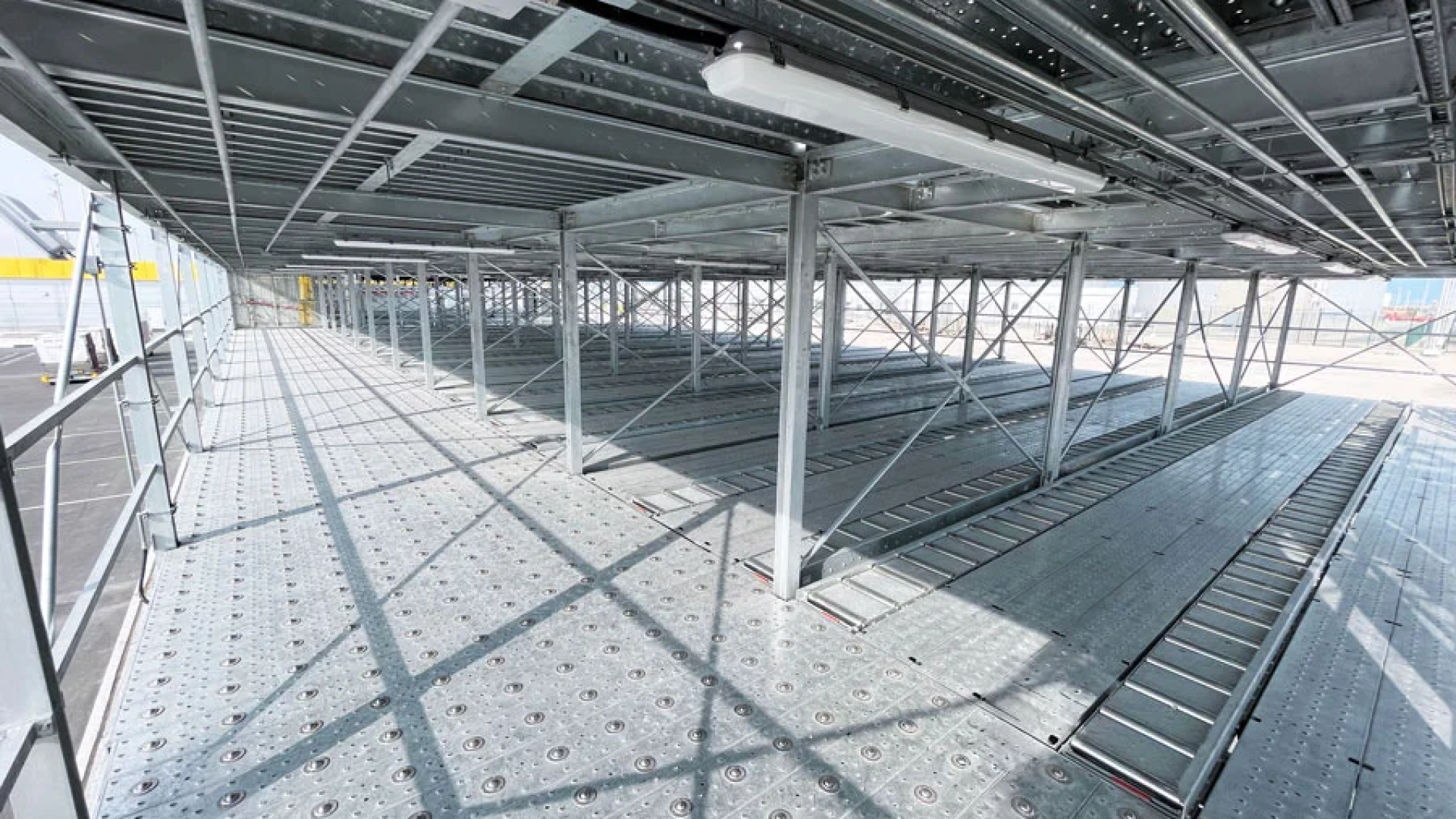
Air cargo facilities operate under constraints that few other logistics environments face. Every square metre of airport land carries premium value, apron and runway zoning restricts horizontal expansion, and operational continuity cannot be compromised during construction. Cargo terminals designed decades ago for lower volumes now process freight loads that exceed their original capacity, yet expanding the building footprint triggers planning complications, car parking ratio assessments and infrastructure costs that make horizontal growth impractical. The vertical space within existing cargo buildings offers the most direct path to increased capacity. Mezzanine systems transform unused cubic volume into functional freight handling area, allowing airports to double or triple processing capacity within the same building envelope without disrupting airside operations or navigating complex expansion approvals.
Why Vertical Expansion Is Critical in Airport Environments
Land within airport precincts is constrained by operational zoning that prioritises aircraft movement, fuel infrastructure and security perimeters over building expansion. Cargo terminals sit between landside access roads and airside aprons, occupying fixed zones that cannot easily expand without affecting runway operations, taxiway clearances or security boundaries. Acquiring additional land within these zones involves aviation authority approvals, operational impact assessments and coordination with multiple stakeholders that can extend planning timelines beyond practical project horizons.
Sydney Airport demonstrates the extreme constraints facing established urban airports. Located just 8 kilometres from Sydney's central business district, the airport is permanently impacted by its inner-city location and surrounded by residential development that prevents any meaningful horizontal expansion. The airport processed more than 41 million passenger journeys in 2024, making it Australia's busiest gateway, yet its physical footprint cannot grow to accommodate increasing demand. These constraints drove the Australian Government to develop Western Sydney International Airport 41 kilometres west of the city centre, a greenfield site that will open in late 2026 as a curfew-free alternative specifically because expanding the existing airport within its urban location proved impossible.
Planning limitations in airport precincts include car parking ratios that tie additional floor area to parking space requirements. Expanding a cargo terminal horizontally may trigger obligations to provide additional parking spaces on land already dedicated to operational functions. Vertical expansion using mezzanine floors increases functional capacity without increasing ground floor area, avoiding or minimising parking ratio triggers depending on local planning interpretation.
Security and operational constraints prevent cargo facilities from shutting down during construction or expansion. Airport cargo operations run continuously with aircraft arrivals, freight processing and truck movements operating around the clock. Construction that disrupts these operations creates cascading delays across airline schedules and logistics networks. Mezzanine installations can be staged to occur during lower-volume periods or in sections that allow partial facility operation, reducing operational impact compared to major building extensions.
Cost comparison between building expansion and internal vertical capacity shows mezzanine systems delivering equivalent floor area at 40 to 60 percent of the cost of new construction. Building extensions require foundation work, structural steel or concrete for walls and roof, services extension and external works including drainage and hardstand areas. Mezzanine installations use existing building structure and services infrastructure, concentrating expenditure on functional floor area rather than building envelope.
Mezzanines for Sorting, Staging and Freight Segregation
Operational separation between freight processing stages improves throughput and reduces handling errors. Mezzanine floors create dedicated levels for specific functions without requiring ground floor space that could otherwise serve vehicle access or bulk storage. Sorting decks on upper levels allow freight to be segregated by destination, carrier or priority while maintaining clear ground floor circulation for forklifts and tugs moving larger items.
Staging areas for outbound freight benefit from elevation above arrival zones. Cargo awaiting aircraft loading can be organised on mezzanine levels accessible via goods lifts or conveyors, keeping it separated from incoming freight and preventing cross-contamination of processing flows. This vertical segregation reduces the time freight handlers spend navigating congested ground floors and improves accuracy in load assembly.
Secure handling zones for high-value or sensitive cargo can be established on mezzanine levels with controlled stair or lift access. Physical elevation combined with access control systems creates secure areas without requiring dedicated ground floor rooms that consume valuable circulation space. Customs inspection platforms and documentation processing areas similarly benefit from mezzanine locations that provide visibility over ground floor operations while maintaining separation from bulk handling activities.
Air cargo facilities processing capacity can be increased by installing a structural mezzanine above staging zones for domestic freight. The upper level handles sorted cargo awaiting truck dispatch while ground floor space remained dedicated to international freight requiring customs clearance and heavy equipment access. The vertical separation can allow parallel processing streams that previously competed for the same floor area, increasing daily throughput without building expansion.
Multi Level ULD Storage Platforms
Unit Load Devices (ULDs) represent one of the most significant ground space challenges facing airport cargo operators. ULDs are standardised aluminium containers and pallets used to load freight and baggage onto commercial aircraft. They are bulky, irregularly shaped and accumulate in large numbers within cargo terminals between flight cycles. An airline operating multiple daily widebody services may cycle hundreds of empty ULDs through a single facility, each requiring floor space while awaiting reassignment, inspection or return to service. The cumulative footprint of empty ULD stockpiles routinely consumes significant portions of cargo terminal ground floor area that could otherwise support active freight processing.
Multi level ULD storage platforms address this problem directly by stacking empty ULD storage vertically within the existing building envelope. Engineered mezzanine structures purpose-built for ULD storage accommodate standard container dimensions and pallet configurations across multiple levels, multiplying storage capacity without expanding the terminal footprint. Purpose-designed rack systems and structural decks are engineered to handle the specific load profiles of different ULD types, including LD3 containers used on narrowbody aircraft and the larger LD7 and LD11 containers common on widebody international services.
Sydney Airport has identified ULD storage as a pressing operational challenge, consistent with the experience of major hub airports across Europe, the Middle East and North America where multi level ULD storage platforms have become standard infrastructure. International airports including Amsterdam Schiphol, Dubai International and Frankfurt Airport have implemented dedicated ULD storage mezzanine systems that remove empty containers from active cargo processing areas, freeing ground floor space for revenue-generating freight handling activity.
The commercial model for multi level ULD storage platforms at Australian airports typically operates on a leasing basis. Airport operators or specialist cargo facility managers invest in the storage infrastructure and lease individual storage bays or zones to individual airlines. This arrangement provides airlines with guaranteed, dedicated ULD storage capacity within the terminal without requiring capital investment in permanent infrastructure, while generating rental income that contributes to the return on the storage platform investment. Lease terms can be structured to reflect seasonal demand variation, with major carriers securing baseline capacity and additional bays available on shorter arrangements during peak periods.
Structural design of ULD storage platforms must account for the specific geometry and weight distribution of containers and pallets in storage configuration. Empty LD3 containers weigh approximately 80 kilograms each, but storage density on multi level platforms means structural loads accumulate quickly across deck areas. Floor systems must be designed to handle concentrated loads from stacked configurations while maintaining sufficient clearance between levels for ground support equipment to position and retrieve containers safely. Access aisles, retrieval systems and lift equipment integrate with the platform structure to ensure containers can be extracted efficiently when required for aircraft loading.
Integration with existing ULD tracking and management systems allows airports and airlines to maintain inventory visibility across storage levels. RFID tagging, barcode scanning or visual management systems embedded in the platform structure support accurate ULD accounting that reduces container loss and improves turnaround efficiency. Platforms can be designed with segregated zones for containers assigned to specific airlines, simplifying retrieval and reducing handling time when containers are required for outgoing flights.
Integrating Mezzanines with Conveyor and Automation Systems
Conveyor systems and automated sortation equipment must be designed into mezzanine structures from the earliest planning stages rather than accommodated through later modifications. Structural engineers and automation system integrators should collaborate during concept design to establish clear spatial envelopes, load transfer points and penetration locations that serve both structural integrity and operational functionality.
Penetrations through mezzanine decks for conveyors, chutes and vertical transport systems require careful structural detailing. Floor openings must be framed with additional beams to transfer loads around the penetration while maintaining adequate edge protection and compliance with guardrail requirements. Larger openings for spiral conveyors or baggage handling systems may require redesigned structural grids to maintain floor load capacity adjacent to the penetration.
Load transfer from automation equipment introduces point loads and dynamic forces that differ from standard distributed floor loading. Conveyor motors, drive units and sortation equipment create concentrated loads at specific locations that must be supported through additional structural members or reinforced connections. Engineers must model these loads accurately based on equipment specifications provided by automation suppliers rather than assuming generic load distributions.
Vibration control considerations apply where conveyor systems or material handling equipment operates continuously. Structural design should limit deflection and resonance that could affect equipment operation or create occupant discomfort. Isolation mounts, damping systems or structural stiffening may be required depending on equipment specifications and installation location.
Clear head height requirements ensure adequate vertical clearance for personnel, equipment and freight movement on both mezzanine and ground levels. Airports typically require minimum clearances of 2.4 to 3 metres depending on operational use, with additional height needed where conveyors or overhead services pass beneath mezzanine structures. Early coordination between structural designers and mechanical services engineers prevents conflicts that reduce functional ceiling heights.
Designing for Heavy Loads and Large Freight
Airport cargo environments impose live loads that exceed standard warehouse mezzanine specifications. Palletised freight consolidated for aircraft loading creates higher densities than typical warehouse inventory, while ULD containers weighing up to 1600 kilograms introduce concentrated point loads that must be supported through mezzanine deck systems and structural framing.
Concentrated point loads from pallet jacks, electric tugs and material handling equipment create localised stresses requiring structural analysis beyond distributed load calculations. Engineers must verify that deck systems can support these point loads without excessive deflection or stress concentration at beam connections. Composite deck systems or reinforced areas may be specified at locations where heavy equipment operates regularly.
Forklift movement on mezzanine floors is possible where structural design accounts for vehicle weight, dynamic forces during acceleration and braking, and potential impact loads. Load ratings of 7.5 to 10 kilopascals or higher may be required depending on forklift capacity and operational requirements. Floor surfaces must provide adequate traction and durability under repeated forklift traffic.
Deflection control maintains floor levelness critical for wheeled equipment operation and prevents damage to goods or equipment from excessive floor movement under load. Australian Standards specify deflection limits based on span and use, with airport cargo applications typically requiring more stringent limits than general warehouse environments to ensure equipment operates reliably and freight remains stable during handling.
Structural engineering verification through detailed calculations and certification to AS 4100 steel structures standards is mandatory for all airport mezzanine installations. Engineers must demonstrate compliance with loading standards, provide construction drawings specifying materials and connections, and certify that completed structures meet design intent and regulatory requirements.
Fire Safety and Regulatory Compliance in 24/7 Operations
Fire rating requirements under the National Construction Code depend on building classification, mezzanine size and proximity to other structures within the airport precinct. Cargo terminals typically fall under Class 7 or Class 8 classifications, with fire resistance levels determined by the relationship between mezzanine and primary building structure. Fire-rated mezzanine systems using intumescent coatings or concrete-encased steel provide protection where separation from adjacent buildings or internal compartmentation requires specific fire resistance periods.
Egress and emergency access design must accommodate 24-hour operations where personnel numbers vary by shift and operational activity. Multiple exit routes separated by required distances ensure that evacuation paths remain available regardless of fire location. Travel distances from any point on the mezzanine to exits must comply with NCC provisions, with shorter limits applying where automatic suppression systems are not installed.
Sprinkler integration extends existing building fire protection to mezzanine levels and the spaces beneath them. Sprinkler coverage must account for obstructions created by structural members, services and stored goods to ensure adequate water distribution during fire events. Water supply capacity and sprinkler head spacing must be verified against AS 2118 provisions for the specific building classification and fire hazard.
Smoke management in cargo facilities prevents smoke accumulation that could obscure exit routes or overwhelm ventilation systems. Natural smoke venting through high-level openings or mechanical exhaust systems maintain tenable conditions during evacuation. Design must demonstrate that smoke will not accumulate faster than it can be exhausted, accounting for combustible materials present in typical cargo handling operations.
Seismic and Structural Resilience
Structural resilience requirements for airport facilities recognise their role as critical infrastructure supporting emergency response and economic continuity. Mezzanine structures in airport cargo terminals should be designed with appropriate lateral bracing and connection details that maintain structural integrity during seismic events or other loading scenarios beyond normal operating conditions.
Seismic design considerations follow AS 1170.4 earthquake actions standards where applicable, with design parameters determined by site location and building importance classification. Airport cargo facilities may be classified as importance level 3 structures requiring enhanced design provisions compared to standard commercial buildings. Lateral bracing systems, moment-resisting connections and foundation details must be engineered to resist horizontal forces while maintaining operational functionality.
Redundancy in structural systems provides resilience against localised failure or damage. Multiple load paths, continuous framing and robust connections ensure that loss of individual structural members does not trigger progressive collapse or compromise overall structural stability. This approach aligns with engineering principles for essential infrastructure that must remain functional under adverse conditions.
ROI: Capacity Gains Without Building Expansion
Doubling usable floor area within the same building footprint improves asset utilisation metrics that airport operators and cargo facility managers use to evaluate infrastructure investment. Throughput increases measured in tonnes processed per square metre or shipments handled per shift demonstrate operational value beyond simple capacity expansion.
Faster freight segregation reduces handling time and labour costs by creating dedicated zones for different cargo types or processing stages. Vertical separation allows parallel workflows that previously competed for ground floor space, eliminating bottlenecks that slow cargo progression through sorting, staging and loading sequences.
Reduced congestion on ground floors improves safety and equipment productivity. Forklifts and tugs move more efficiently when upper-level storage removes obstacles from circulation paths. Reduced travel distances and fewer conflicts between personnel and vehicles decrease accident risk and equipment damage.
Lower cost per processed unit reflects improved operational efficiency across labour, equipment and facility utilisation. Fixed costs including building lease, utilities and overhead are distributed across higher volumes, improving financial performance without proportional increases in operating expenditure.
Delivering Mezzanine Solutions for Airport Cargo Facilities
Mezzanine systems allow airports to scale freight operations within existing building footprints while maintaining structural integrity, regulatory compliance and integration with automation infrastructure. Unistor approaches airport cargo facilities as critical infrastructure requiring engineered design that accounts for heavy loads, continuous operations and long-term operational flexibility. Structural certification, fire safety compliance and coordination with system integrators ensure that mezzanine installations support demanding airport environments while delivering measurable capacity improvements and operational efficiency gains.
Contact Unistor to Discuss Airport Mezzanine Design
Speak with Unistor about mezzanine systems for your cargo facility. Our engineering team works with airport planners, architects and logistics consultants to deliver compliant solutions that maximise vertical space and integrate with freight handling infrastructure.
Use our warehouse efficiency calculators to assess space gains and compliance feasibility before planning expansion.