

What does the floor of a self-storage facility actually need to do and for how long?
For architects, engineers and developers working on multi-level self-storage facilities, the answer carries more commercial weight than most initial specifications acknowledge. Trolleys loaded with dense furniture, appliances and business inventory move across every aisle, every day, in unpredictable patterns. Tenants judge facility quality within seconds of entering a corridor. Compliance obligations under the National Construction Code apply to the mezzanine structure as a whole, including the floor. And the asset will typically operate for 15 to 25 years before any major structural intervention is considered.
The flooring decision made at construction carries all of that. Getting it right reduces steel tonnage, shortens the installation programme, supports NCC compliance and delivers a facility that holds its value and occupancy across the full hold period. Getting it wrong introduces a compounding set of costs that rarely appear on the original project budget.
The Limitations of Standard Particleboard Mezzanine Flooring
Traditional mezzanines for self-storage are constructed entirely onsite. Lengths of top hat cold rolled sections, SHS columns and purlins for the bearer construction are delivered to site unprocessed, and the build involves measuring and cutting every component to length on the ground before fixing together using tech screws. There is no prefabrication. Every metre of steel is handled, cut and assembled by tradespeople working within the facility. In Australia, where construction labour rates are among the highest in the world, this conventional model carries a significant and often underestimated cost burden before a single sheet of flooring is laid.
The conventional approach then uses 22 mm raw particleboard sheet laid over closely spaced purlins, typically at 400 to 450 mm centres. It is familiar and appears cost-effective at installation. Over the operational life of a storage facility, however, the performance limitations accumulate.
Closely spaced purlins exist because particleboard cannot bridge long spans under sustained load. Each additional purlin is fabricated steel, welded connections, transport weight and installation time. The result is a steel-heavy mezzanine frame that costs more than the structural demand of the application requires.
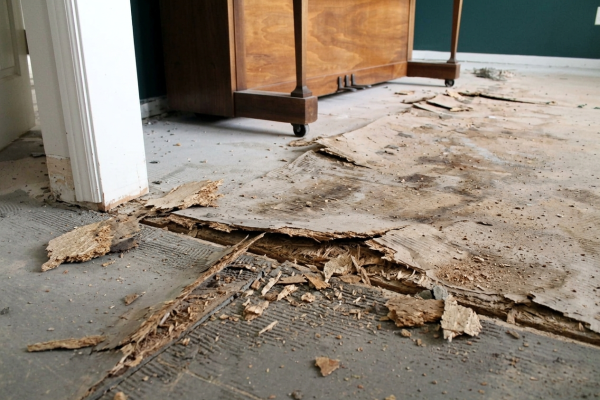
Raw particleboard is moisture-sensitive. In a self-storage environment where humidity fluctuates seasonally and sprinkler discharge is a contingency, untreated sheet material absorbs moisture at edges and joins. Swelling, surface delamination and edge softening follow. On-site epoxy sealing is often required, adding programme time and introducing quality variability depending on application.
Sheet joins degrade under repeated load. Even well-laid installations develop lips and gaps at joins over time, creating trip hazards and a surface that looks and performs poorly. Remediation means cutting out and replacing individual sheets. This is a recurring cost absent from the original budget.
The unfinished underside of a particleboard floor forms the ceiling of the aisle below. In a multi-level facility, this produces dark, visually cluttered corridors that reduce perceived quality and require additional lighting investment to partially compensate. There is no practical way to retrofit a quality finish once the floor is installed.
No system warranty applies. Individual sheet products carry material warranties, but the floor as a functional assembly (spanning, loading, deflecting, joining) is unwarranted. When problems arise, the rectification cost falls entirely on the facility owner.
What Makes Levelspan® Structurally Different
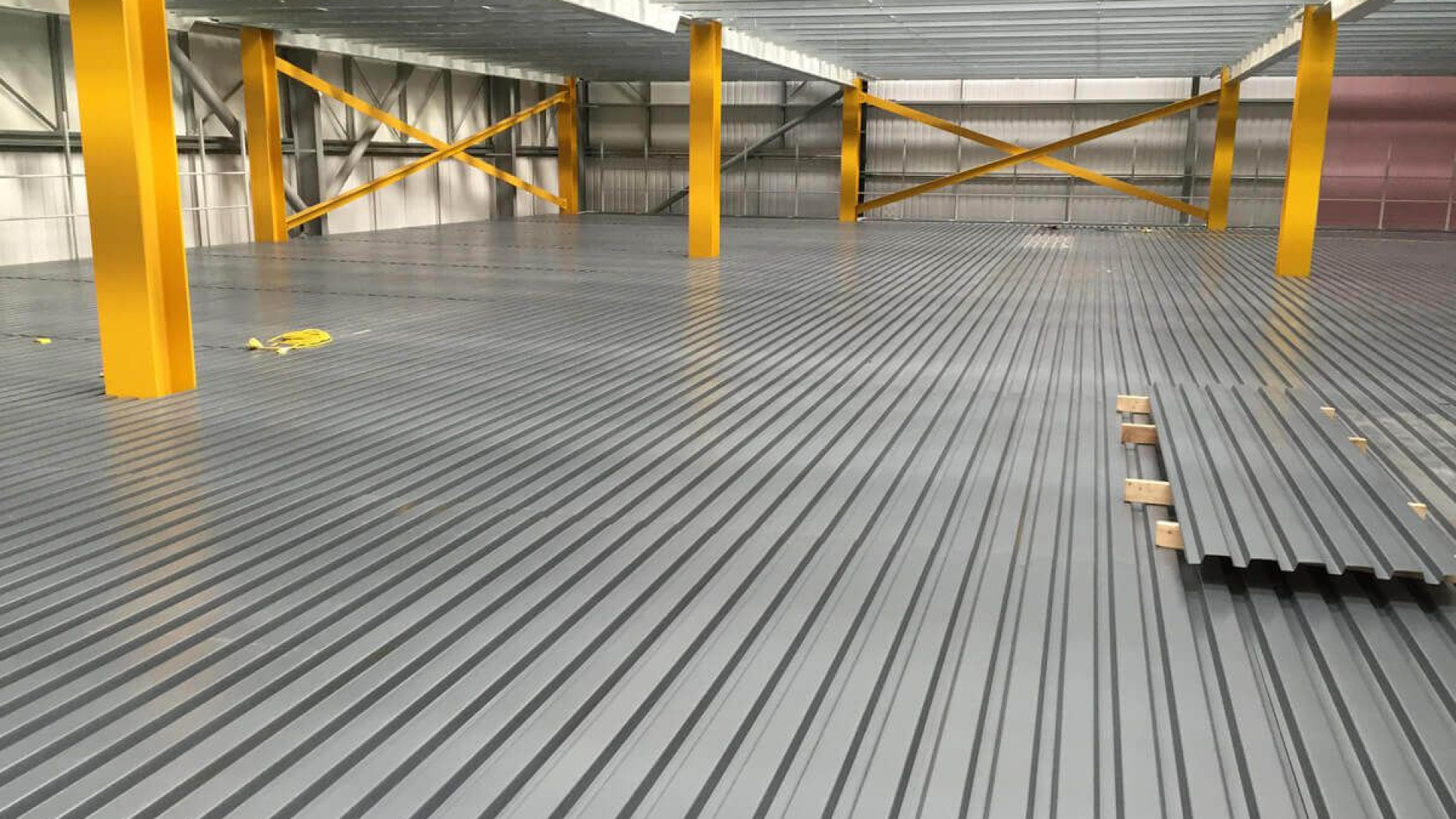
Levelspan® is Unistor's engineered sub-floor system for mezzanine applications. Its structural foundation is a roll-formed high-tensile steel sub-deck that spans up to approximately 1500 mm between supporting beams, more than three times the typical purlin spacing in a traditional build. The direct consequence is a substantial reduction in secondary steel: fewer purlins, fewer welded connections and a faster installation.
Floor flatness is maintained under sustained and dynamic load through the engineered deflection profile of the sub-deck, not through dense support spacing. This produces a more consistent surface across the life of the facility and a cleaner structural zone between floor levels with fewer obstructions.
The sub-deck is paired with prefinished decking panels. Options include 25 mm Unilin® P5 Deluxe (a moisture-resistant, high-density panel manufactured to tight dimensional tolerance) and ResinDek®, an engineered composite panel suited to high point-load applications. Both are manufactured with tongue-and-groove edges, creating a continuous interlocked floor surface. No on-site sealing, epoxy or surface treatment is required. The panel arrives prefinished and ready to lay.
The underside of the Levelspan® assembly carries a white finish. In storage aisles extending 50 metres or more, a white reflective ceiling surface materially improves brightness without additional lighting infrastructure. It’s a visible quality signal to every prospective tenant who walks the floor.
The entire system is covered by a 10-year warranty as a complete assembly, not a collection of individually warrantied components. For developers, that is a documented commercial commitment against system failure with a clear basis for rectification.
Installation Efficiency and Reduced Steel Tonnage
Wider joist spacing means fewer secondary steel members across the full floor plate. For a mid-sized multi-level self-storage facility, the reduction in steel tonnage is meaningful — across fabrication, delivery and erection. Premanufactured modular frame components arrive on site dimensioned and ready for installation, compressing the programme and reducing labour input per square metre.
The elimination of on-site surface treatment removes both a programme activity and a quality variable. Every day saved in floor installation is available for fitout trades and practical completion. For builders managing tight programmes, this compression of the critical path has direct commercial value that partially or fully offsets the engineering specification of the sub-deck system.
Fire Compliance and NCC Integration
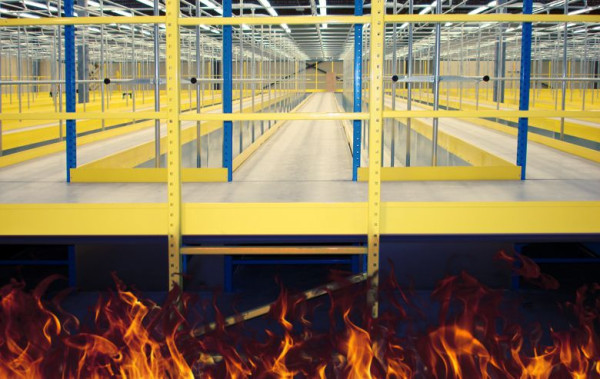
Fire safety compliance under the National Construction Code directly implicates the mezzanine flooring system. Levelspan® is designed to accommodate sprinkler installations both above and below the deck. The wider spacing between structural members and the steel deck subflooring provides greater flexibility in sprinkler head placement, supporting fire pathway compliance without geometric compromise.
Standard particleboard installations on closely spaced purlin grids create a dense obstruction field in the structural zone. Purlin grids at 400 to 450 mm centres constrain sprinkler head placement, can produce coverage shadows and may require engineering workarounds that add cost and programme risk to the compliance submission.
Levelspan® system documentation like structural drawings, span tables and specifications, is available to certifying engineers and building surveyors as part of the product package. This reduces the documentation burden on the design team and supports a cleaner certification pathway. Project-specific compliance obligations vary by building classification and jurisdiction and are confirmed by the project certifier.
Lifecycle Value and Reconfiguration
The cost comparison between standard practice for self storage mezzanine and Unistor’s Levelspan® engineered system must account for the full lifecycle of the asset, not only the capital cost at construction. The table below compares the two systems across the key performance and commercial considerations.
|
Consideration |
Standard Particleboard |
Levelspan® Engineered System |
|
Joist/purlin spacing |
300–450 mm typical |
Up to ~1500 mm |
|
Steel tonnage |
Higher |
Reduced |
|
On-site surface treatment |
Often required |
Not required |
|
Floor finish at installation |
Raw sheet |
Prefinished panel |
|
Underside aesthetic |
Unfinished |
White reflective finish |
|
Moisture sensitivity |
High — edges and joins degrade |
Low — moisture-resistant panel options |
|
Surface join performance |
Degrades under load over time |
Tongue-and-groove, maintains flatness |
|
Sprinkler integration flexibility |
Constrained by purlin grid |
Designed for above and below deck |
|
NCC fire pathway support |
Variable — design-dependent |
Integrated into system design |
|
System warranty |
None standard |
10-year system warranty |
|
Reconfiguration capability |
Difficult — not designed for disassembly |
Modular — sections can be added or removed |
|
Replacement cycle |
Shorter — surface degradation over time |
Extended — engineered for long operational life |
The lifecycle cost advantage of Levelspan® accumulates over time. Reduced replacement cycles, lower maintenance intervention, the absence of periodic sealing or surface treatment, and the elimination of trip-hazard remediation all represent ongoing operational savings that are absent from the headline installation cost comparison. For a facility operated over 15 to 25 years, a typical hold period for self-storage assets, the difference between the two approaches is significant.
The Right Specification from the Start
The flooring system in a multi-level self-storage facility affects structural efficiency, compliance documentation, tenant experience and long-term maintenance cost. Levelspan® addresses all of these through its core engineering: reduced steel tonnage, prefinished panel options, white underside finish, NCC-aligned fire pathway design and a 10-year system warranty.
For developers and operators investing in Australian self-storage, the flooring specification is not a line item to value-engineer late in the design process. It is a decision that compounds across the life of the asset, in either direction.
Discuss Your Self-Storage Flooring Requirements with Unistor
Unistor provides free design consultations for architects, engineers and developers specifying flooring systems for self-storage mezzanines across Australia. The Levelspan® system is available with full technical support, NCC compliance documentation and a 10-year system warranty.
Contact Unistor to arrange a free design consultation on your self-storage flooring project.